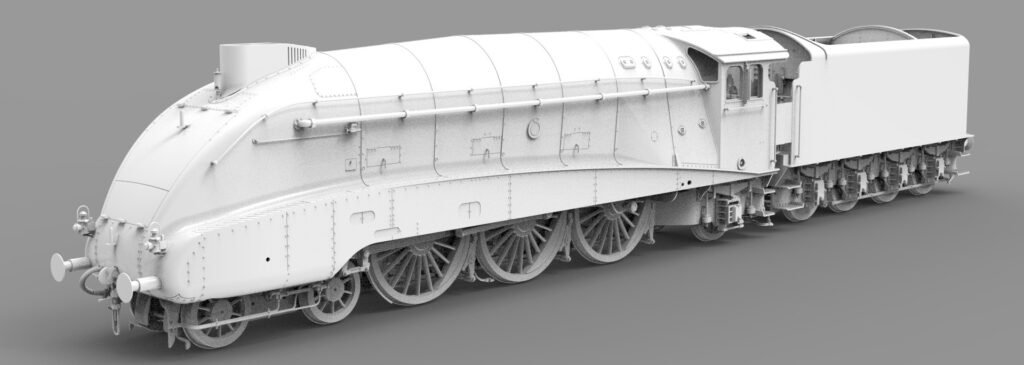
Finescale Brass LNER Class A4 Locomotive
Specifications
All models
- All-brass & Metal construction
- Fully detailed cab, with real copper pipes and firebox glow.
- Working Prototypical third cylinder
- Working main front directional marker lights
- Maxon motor, with ball bearing racers
- ABC gearbox (made in the UK)
- Suitable for operation on 5ft radius curves or above
- Scale distance between Loco and tender
- Opening cods mouth and smokebox door
- All analogue running locomotives DCC prepared (ZIMO)
DCC sound and smoke-fitted models
- Zimo MS950 sound decoder
- 60x30x10mm 3W bass reflex speaker
- Dual-driver 38x20x12mm 4W planar speaker
- Zimo RAUSI2 synchro smoke generator
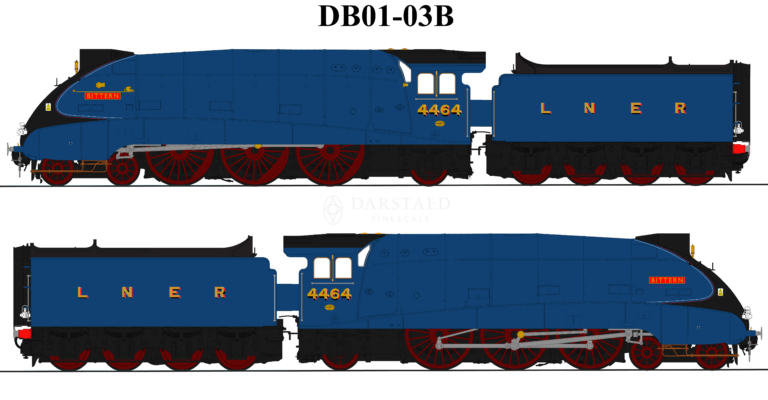
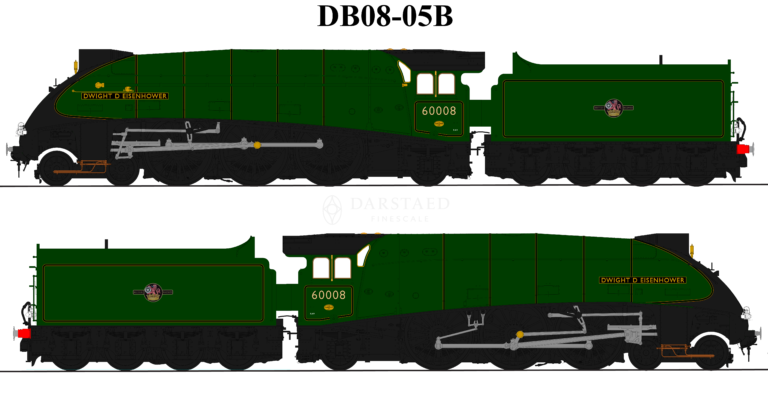
Darstaed A4 Model Lineup
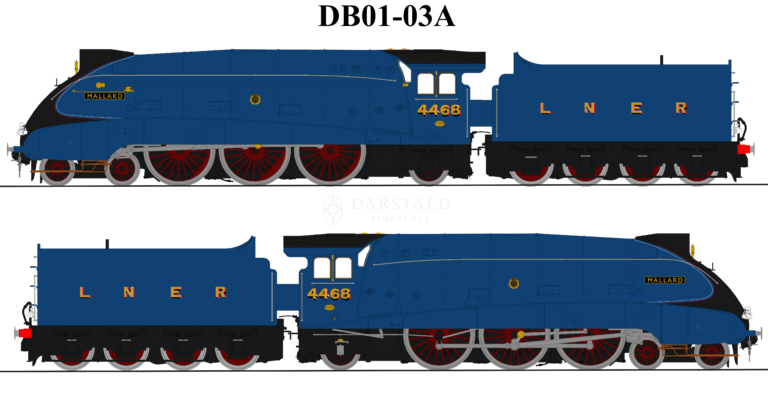
No. 4468 LNER Garter Blue (present day, as preserved)
The most famous A4, Mallard broke the world speed record in July 1938 and holds it to this day. The engine is preserved and on static display at the National Railway Museum in York.
No. 4464 LNER Garter Blue (as preserved)
Bittern took charge of the last A4-hauled passenger service (between Glasgow and Aberdeen) in September 1966. The engine is preserved and currently undergoing extensive overhaul at Crewe.
No. 4482 LNER Garter Blue (1938–42 and 1947–49)
Golden Eagle entered service in December 1936 and during its first stint in Garter Blue (1938–42, prior to receiving wartime black) was based at Haymarket, Gateshead and Heaton sheds.
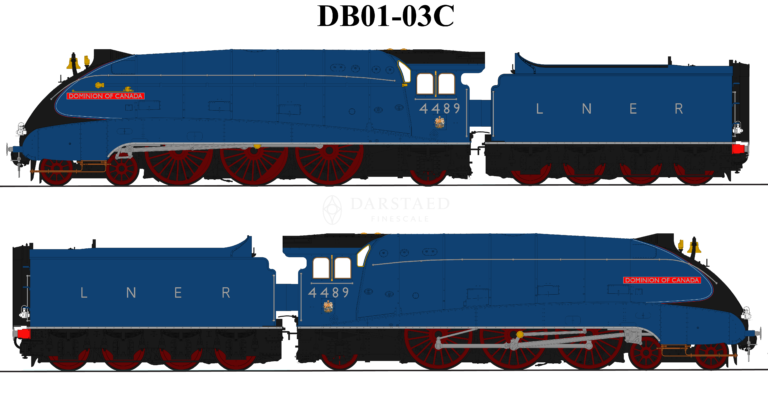
No. 4489 LNER Garter Blue (present day, as preserved)
One of the original ‘Coronation’ engines, Dominion of Canada now resides at the Railway Museum of Greater Montreal, Canada.
No. 60012 BR Blue (1949–52)
This engine hauled the first northbound ‘Coronation’ train in July 1937, when it reached York in just 2hr 35min. During its time in BR blue livery, it was based at Haymarket (with a short spell at Polmadie) and regularly operated Edinburgh–Glasgow trains.
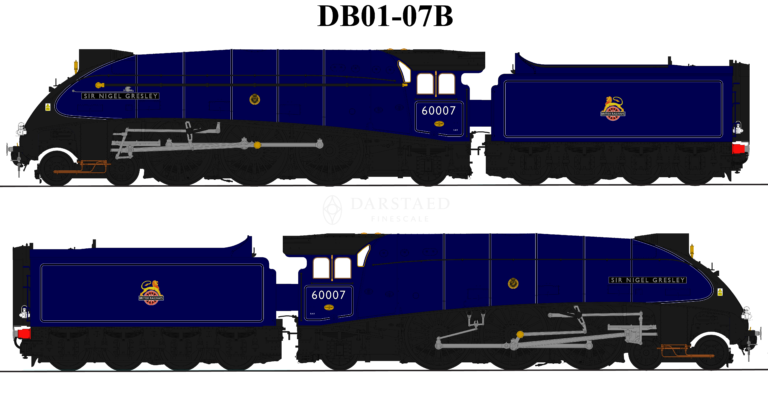
No. 60007 BR Blue (present day, as preserved)
New to Kings Cross shed in 1937, ‘Sir Nigel’ was the 100th ‘Pacific’ engine built to his design and so named in his honour. One of the engines allocated to Glasgow–Aberdeen expresses in the 1960s, it was preserved and operates main-line charters to this day.
No. 60017 BR Green (1949–63)
Silver Fox sported a stainless steel fox on its boiler sides until withdrawal and was the first to be retrofitted with a Kylchap double blastpipe and chimney (in 1957). It operated the final A4 passenger train from Kings Cross (to Leeds) in October 1963 and was scrapped shortly afterwards
No. 60007 BR Green (1952–66)
Sir Nigel Gresley carried BR green from 1952 and holds the post-war speed record for steam engines, having reached 112mph down Stoke Bank in May 1959.
No. 60008 BR Green (1952–63/Preservation)
Originally ‘Golden Shuttle’, this engine was renamed in 1945 to honour the Supreme Commander of Allied Forces (Europe) during WW2. It is preserved today as a static exhibit at the National Museum of Green Bay, Wisconsin.
No. 60011 BR Green (1952–63)
‘Empire of India’ spent almost all its life in Scotland, from allocation to Haymarket in 1938 to withdrawal when at Aberdeen in 1964. Prior to WW2, the engine clocked up a century, having hauled ‘The Coronation’ between Edinburgh and London on 100 occasions.
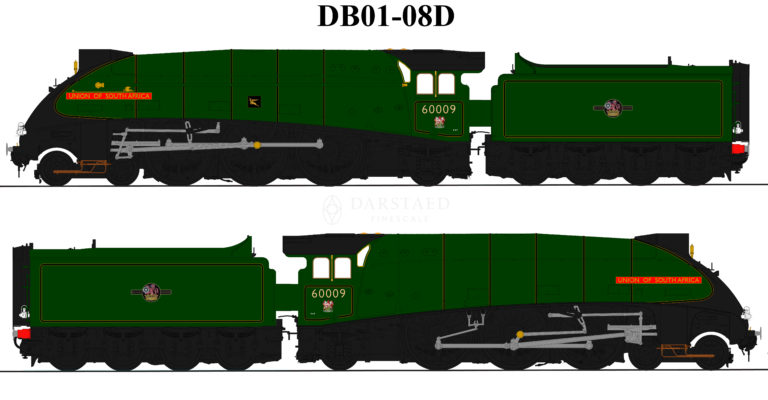
No. 60009 BR Green (1952–63/Preservation)
This engine clocked up the highest mileage of the A4 class, with 1,900,000 covered between 1937 and 1966. Based in Scotland from the start, it hauled both the first and last southbound ‘Elizabethans’ and is currently stored in Fife.
No. 60022 BR Green (1952–63)
‘Mallard’ received BR green in July 1952 and with its corridor tender (fitted in 1948) was a regular choice for non-stop workings between London and Edinburgh.
No. 60027 BR Green (1952–65)
Another engine that spent its entire life based in Scotland, ‘Merlin’ moved from Haymarket to St Rollox in 1962, where it hauled Glasgow–Aberdeen expresses for another three years until withdrawal.
No. 60024 BR Green (1952–66)
‘Kingfisher’ wore purple, BR blue and then BR green during the post-war period. As a Haymarket engine with a corridor tender, it hauled many of the non-stop Anglo-Scottish trains before being enlisted for internal Scottish workings in 1963.